
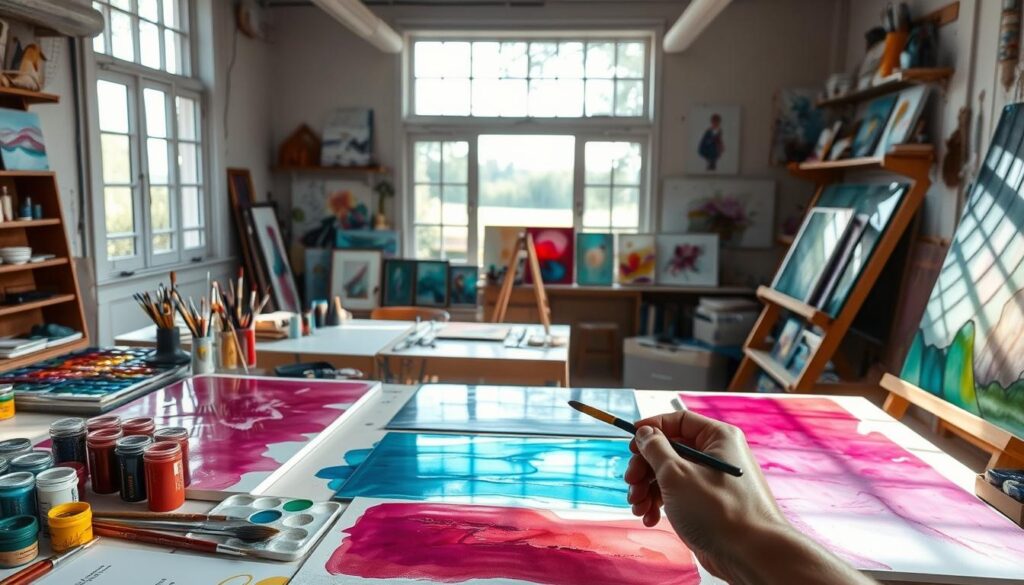
Capturing the essence of transparent materials challenges even experienced artists. Unlike solid objects, glass demands you paint its interactions with light and environment rather than its physical form. This guide reveals how to bypass common pitfalls through observational techniques used by professional creators.
You’ll discover why traditional painting methods often fail with translucent surfaces. The secret lies in training your eye to see distorted reflections and color shifts instead of predictable shapes. Many beginners struggle because they paint what they expect to see rather than what’s actually visible.
Successful artists approach these projects by focusing on three core principles: light distortion, layered transparency, and environmental interplay. Your brain might insist a drinking glass should appear clear, but your brush must capture the subtle blues or grays hidden in its curves.
This artistic process becomes easier when you embrace right-brain thinking. Instead of analyzing objects logically, observe how light bends through a vase or warps nearby items. These visual truths create convincing illusions of glass in art, whether you’re crafting decorative pieces or photorealistic still life works.
By the end of this guide, you’ll possess tools to transform flat surfaces into dynamic, lifelike creations. Let’s explore how professional techniques can elevate your approach to one of painting’s most intriguing challenges.
Preparing Your Workspace and Materials for Glass Painting
Before your brush touches glass, your environment needs careful attention. Proper setup prevents smudges, uneven drying, and color contamination. Start by choosing a flat, stable surface away from direct sunlight.
Choosing the Right Glass Surface
Flat sheets and simple vases work best for newcomers. These surfaces let you practice without dealing with curves. Advanced artists often pick textured glass or ornaments for dimensional effects.
Selecting Appropriate Glass Paint
Three main types dominate the craft. Enamel sticks to smooth finishes, while acrylic works on porous materials. Epoxy creates permanent bonds but requires mixing.
| Paint Type | Best For | Drying Time | Durability |
|---|---|---|---|
| Enamel | Decorative pieces | 24-48 hours | Dishwasher-safe |
| Acrylic | Window art | 2-4 hours | Hand-wash only |
| Epoxy | Outdoor items | 72 hours | Weatherproof |
Cleaning and Priming for Optimal Results
Wipe surfaces with vinegar solution before painting. Remove fingerprints using lint-free cloths. Let pieces dry completely – moisture causes peeling.
Layering and Shading Techniques for Realistic Glass Painting Effects
Translucent surfaces demand a different approach to color application than solid objects. Success comes from building depth through strategic transparency rather than full coverage. This technique transforms flat artwork into dimensional pieces that mimic light passing through actual materials.
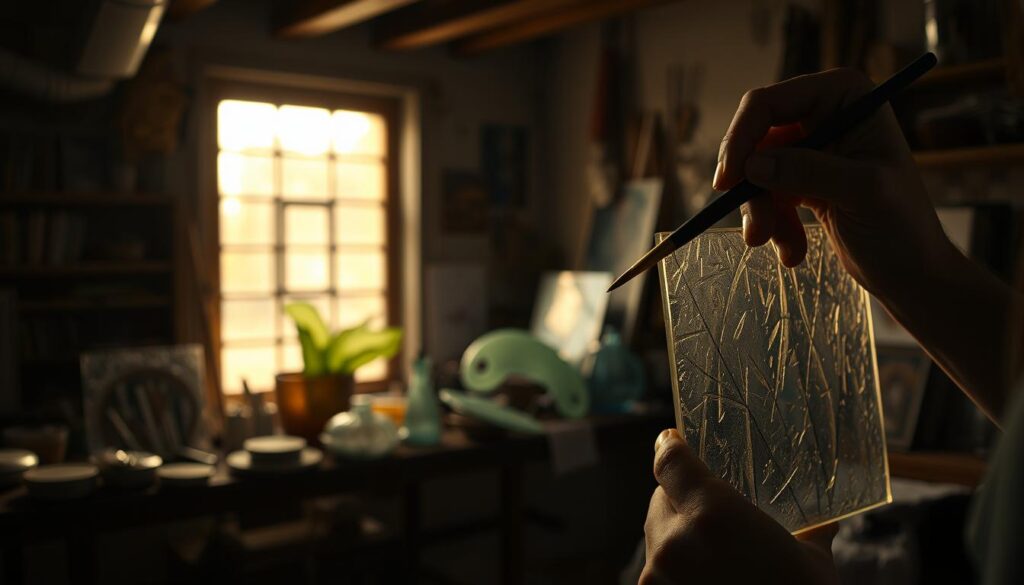
Understanding the Glazing Process
Thin, watered-down layers paint create gradual tonal shifts. Begin with 1:3 paint-to-water ratios for initial washes. Each application needs complete drying time – rushing causes muddy results.
This process helps capture reflected hues in clear objects. A simple vase might require 8+ transparent coats for realistic depth. Add small amounts of blue to white for cool glass effects.
Balancing Transparency and Solidity
Identify areas needing structural definition. Thicken mixtures slightly for edges and support points. Keep central sections diluted where light penetrates deepest.
Notice how surrounding colors tint transparent surfaces. A drinking glass might show faint greens from nearby objects. Capture these details using semi-opaque strokes over dried layers.
Step-by-Step Process to Achieve Photorealistic Glass Painting
Creating lifelike glass surfaces requires a systematic approach. Start with a 30cm x 30cm pre-primed canvas and artist-grade paints. Your tools will include specific brushes: a size 6 filbert for broad strokes and a size 5 Kolinsky sable for fine detail work.
Establishing a Strong Foundational Sketch
Use a 3B pencil to map shapes and lines. Focus on perfecting ellipses – these curved forms define glass objects’ perspective. Light pressure ensures easy corrections. Capture every distortion caused by light refraction.
Building Depth Through Incremental Layers
Follow this seven-stage method to develop dimensionality:
| Step | Materials Used | Purpose |
|---|---|---|
| 1. Initial Wash | Burnt Umber + Water | Warm undertones |
| 2. Darkest Darks | Mars Black | Value structure |
| 3. Color Strings | Mixed Tones | Smooth transitions |
| 4. Mid-Tones | Wet-on-Wet Blend | Transparency effect |
| 5. Background | Yellow Ochre | Environmental context |
Mix nine value gradations between black and white for seamless transitions. Thin paints with water to maintain translucency. Let each layer dry completely before adding the next.
Incorporating Detailed Highlights and Finishing Touches
Apply titanium white with the Kolinsky brush for crisp reflections. Study how light hits curved surfaces – place highlights opposite shadow areas. Use dry brush techniques for faint secondary glimmers that suggest surface texture.
Finalize your piece by stepping back 6 feet. This reveals areas needing adjusted contrasts or softened edges. Your painting should now capture both the solidity and fragility of glass.
Conclusion
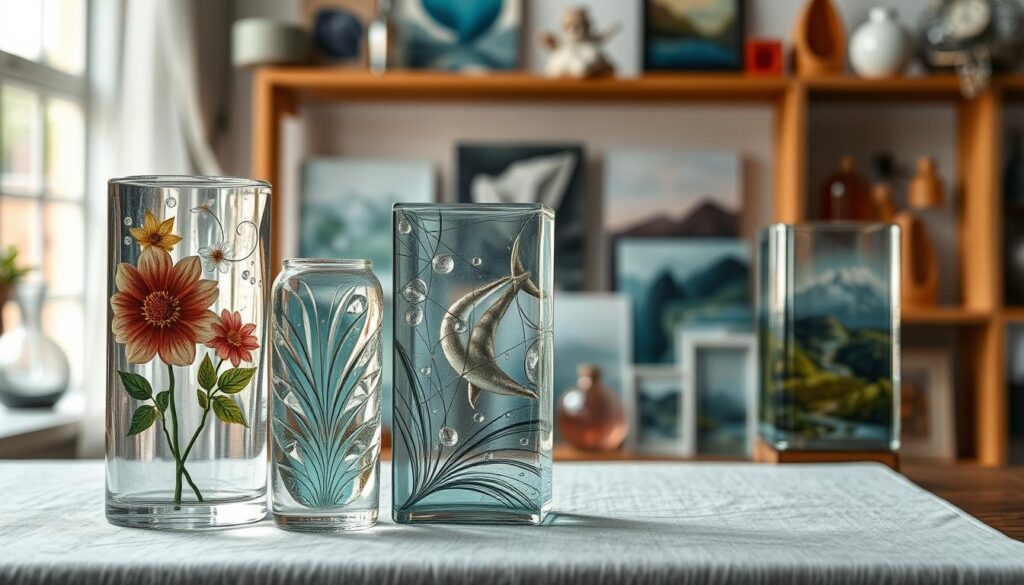
Perfecting translucent surfaces in art demands both discipline and curiosity. While this guide gives you proven methods, true mastery comes through persistent practice. Expect to redo lines and adjust colors repeatedly – each revision sharpens your eye.
Successful painting balances strict technique with creative risk-taking. You’ll learn paint behaviors through trial, discovering how watery mixes interact with smooth surfaces. Keep a journal to track which materials yield desired effects.
The process teaches transferable skills. Observing light through a vase trains you to paint glass, water, or metallic reflections. These abilities elevate entire life studies, not just transparent objects.
Your artistic style emerges through experimentation. Try unconventional tools – sponge daubs create organic textures, while palette knives carve crisp edges. Every finished piece reveals new ways to manipulate form and finish.
Remember: progress outweighs perfection. Each stroke brings deeper understanding of how light defines reality. Now take these techniques forward – your next blank surface awaits transformation.